
The Imaginary Invalid
Molière's last comedy, adapted by Bill Irwin
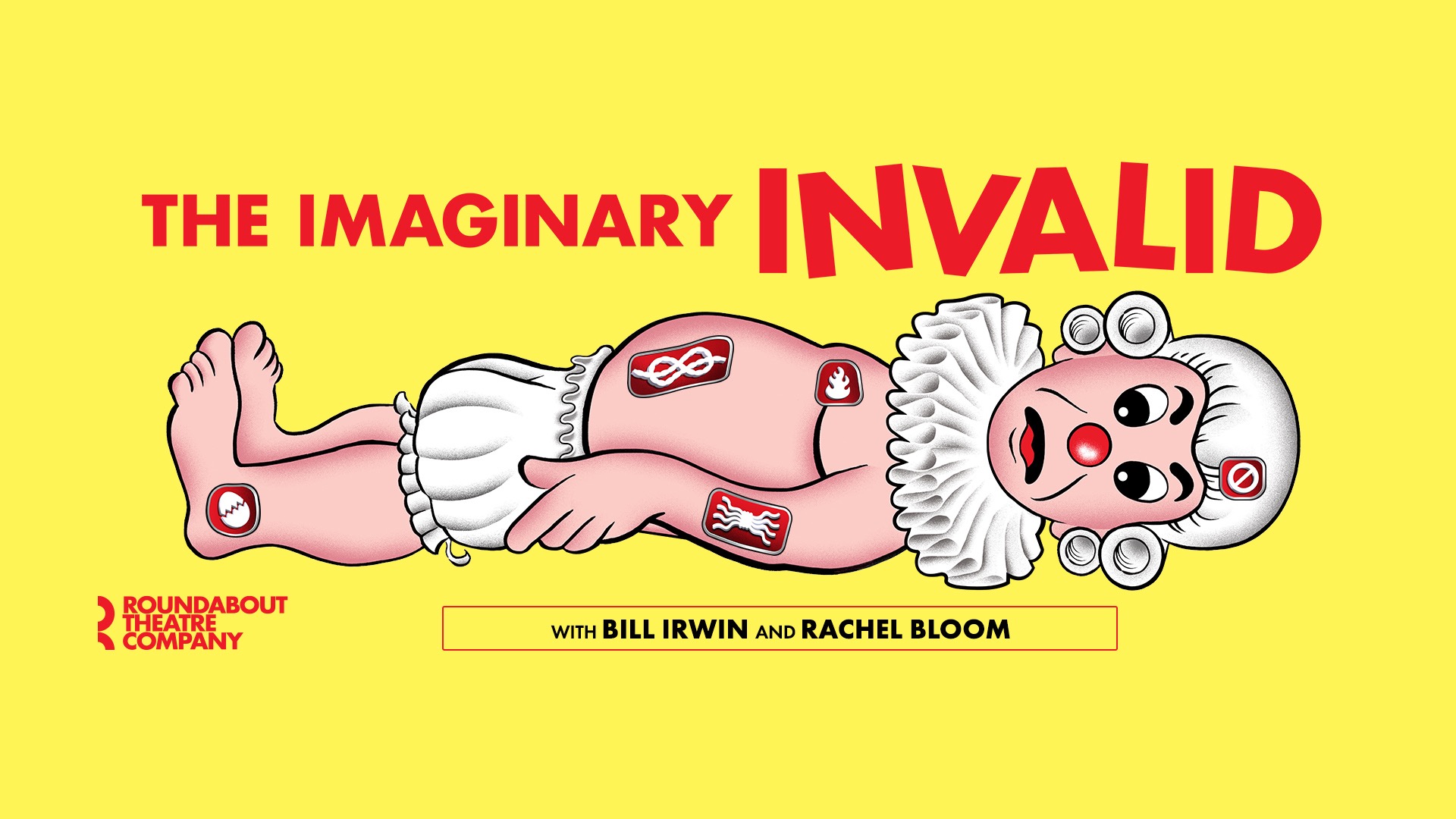
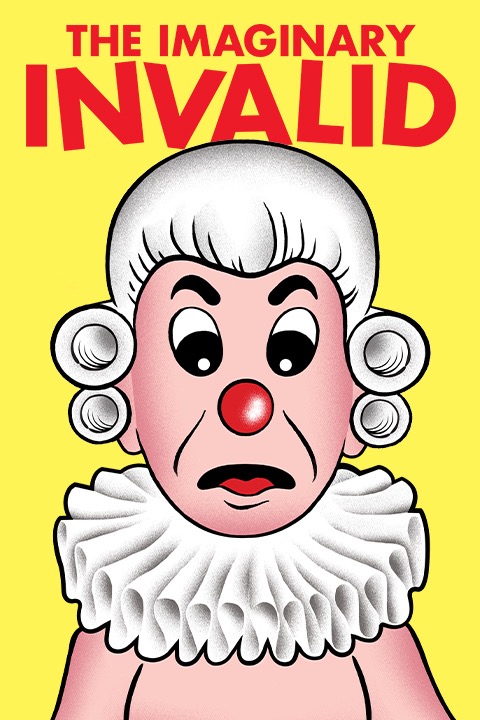
Bill Irwin's new adaptation of Molière's last comedy: a rich hypochondriac in 17th-century Paris trusts doctors so completely that he picks a doctor-to-be as his daughter's husband.
Quick take
- Play
- 1h 30m · no intermission
- Todd Haimes Theatre
- Ages 14+
- Opened 2026
- Based on Molière's 1673 comedy Le Malade imaginaire
- 5 performances a week, dark on Mondays
The Imaginary Invalid showtimes
All times Eastern. Schedule last checked Nov 7
- 3:00 PMMatineeTomorrow
- 7:00 PMEvening
- 2:00 PMMatinee
- 8:00 PMEvening
- 7:00 PMEvening
- 7:00 PMEvening
- 2:00 PMMatinee
- 8:00 PMEvening
Our guide to The Imaginary Invalid
On this page 9 sections
What it is
The Imaginary Invalid is a comedy by Molière, the 17th-century French actor, playwright and director, in a new English version by Bill Irwin. Its central figure, Argan, is a rich Parisian who is certain he is gravely ill. He is not, but his faith in doctors and their remedies rules his household, down to the choice of a husband for his elder daughter. Molière wrote it in French as Le Malade imaginaire, and English versions have also gone by The Hypochondriac and The Would-Be Invalid.
This is a revival of a classic rather than a new play, though the script is new. Irwin began by asking Doug Skinner for a new, literal English translation and then reworked it into his own adaptation. Brandon J. Dirden directs, and Roundabout Theatre Company produces it at the Todd Haimes Theatre as a limited engagement, the first production of the company's 2026-2027 Broadway season. As of October 2026, Irwin also plays Argan, a part he first took on as a high school student.
It was the last play Molière wrote, and he was playing Argan in its original run when he died. On Broadway, the play had not been seen since 1967, so this staging ends a gap of nearly 60 years.
The story
The outline below follows Molière's original text; this adaptation runs as a single act.
The play is set in Argan's household in 17th-century Paris. Argan fusses over his medicines, checks the apothecary's bill and bickers with Toinette, a quick-witted maid who gives as good as she gets. His second wife, Beline, has soothing words for every complaint and one eye on his fortune.
The trouble starts with a wedding. Angelique, Argan's elder daughter, loves a young man named Cleante, so when her father says he has picked a husband for her, she assumes the news is good. It is not. Argan means Thomas Diafoirus, a physician's son on the verge of becoming a doctor himself, because a son-in-law with a medical degree would keep care close at hand. Toinette tells her master exactly what she thinks of the plan. Beline calms him down and nudges him toward rewriting his will in her favor, with a notary on hand, while Toinette promises Angelique she will get a message to Cleante.
Cleante slips into the house disguised as a replacement music teacher. The two Diafoirus men pay a call: the son recites stiff, rehearsed compliments, and the father brags that the boy wants nothing to do with modern medical ideas. Cleante and Angelique then swap vows of love disguised as a made-up opera scene, sung right under Argan's nose, until he puts a stop to it. He gives his daughter four days to accept Thomas, with a convent as the alternative. Argan's brother Beralde arrives and takes his mind off things with a show of singers and dancers.
In the last act, Beralde, who has little faith in doctors, argues that Argan is perfectly healthy and that physicians know far less than they claim. When the apothecary Fleurant is sent away, Purgon, Argan's doctor, flies into a rage, drops his patient and forecasts a grim decline. Toinette then turns up in disguise as a visiting doctor whose absurd advice overturns every treatment Argan has ever received. What Argan does next is described at the very end of this page.
The writing
Molière wrote the play as a comédie-ballet, a form that blends spoken comedy with music and dance. The 1673 original runs in three acts, with musical interludes between them and a musical finale. Marc-Antoine Charpentier composed the music and Pierre Beauchamp created the dances. Molière had made earlier works in this form with Jean-Baptiste Lully, the court composer, but the two had fallen out, so he turned to Charpentier.
Molière drew several of the characters from the stock types of the commedia dell'arte. Argan has the outline of Pantalone, the doctors recall the Dottore, Angelique and Cleante are the Innamorati, and Toinette is a cousin of the servant Columbina. The targets are medicine and hypochondria, but the plot also turns on money and marriage. Irwin has described the play as a satire of medicine and money that is also about mortality and family. He calls it his favorite play, and also a problem play that he wanted to solve together with Dirden.
The 1917 and 1967 Broadway productions were billed as translations; this one is billed as an adaptation. For this staging, John Gromada has written original music and also designed the sound.
The production
As of October 2026, the company has eight actors, with Irwin as Argan. Rachel Bloom makes her Broadway debut as Toinette; she co-created and starred in the TV series Crazy Ex-Girlfriend, which won her a Golden Globe. Ava Lalezarzadeh, who made her Broadway debut in English, plays Angelique, and Daniel Croix Henderson makes his Broadway debut as Cleante. Dylan Baker, a Tony nominee for La Bête, is Beralde, and Crystal A. Dickinson, a Theatre World Award recipient who has appeared on Broadway in You Can't Take It With You and Clybourne Park, is Beline.
With more characters than actors, some performers double up. As of October 2026, Brooks Ashmanskas plays both physicians, Dr. Diafoirus and Purgon; he has three Tony nominations, for The Prom, Martin Short: Fame Becomes Me and Smash. Hiram Delgado, whose Broadway credits include the Tony-winning revival of Take Me Out, covers three roles: Thomas, the apothecary Fleurant and the notary Bonnefoy. Four understudies back up the company: Brandon Dial, Eboni Flowers, Madeline Seidman and Bill Timoney.
History
Molière, whose birth name was Jean-Baptiste Poquelin, was born in Paris in 1622. Le Malade imaginaire had its world premiere at the Théâtre du Palais-Royal in Paris on February 10, 1673, with Molière as Argan. On February 17, 1673, he was taken ill during the fourth performance, got through the show and died later that evening.
Canada's Stratford Festival staged it in 1958, 1974, 1993 and 2016. London's West End saw it in 1968 at the Vaudeville Theatre, where Richard Wordsworth played Argan. In 1990, the Théâtre du Châtelet in Paris presented it with Les Arts Florissants, conducted by William Christie, performing the original music and dances. In the United States, Yale Repertory Theatre used a version by James Magruder in 1999, and the American Conservatory Theater in San Francisco staged an adaptation by Constance Congdon in 2007.
The play first reached Broadway at the Liberty Theatre, opening on March 19, 1917, and closing on March 31 after eight performances. That production used Katherine Prescott Wormeley's translation and was produced by Charles Coburn and Ivah Wills Coburn. Fifty years later, the American National Theatre and Academy produced it at the ANTA Theatre, today the August Wilson Theatre, in a translation by Miles Malleson, directed by Jack Sydow. That version began previews on April 26, 1967, opened on May 1 and closed on May 13 after six performances, with Denholm Elliott as Dr. Diafoirus.
The road to this revival began on April 16, 2026, when Roundabout announced a 2026-2027 season that would open with it. Performance dates followed on July 21, 2026, and the full cast and design team on August 17, 2026. Previews began on September 25, 2026, and opening night was set for October 22, 2026. At the Todd Haimes Theatre, the season continues with Mix and Master and The Full Monty.
The ending (spoilers)Contains spoilers. Tap to read
In Molière's original, Argan decides to test his family by pretending to be dead. Beline is delighted and shows how much she wanted his money, while Angelique mourns him sincerely. Argan then agrees to let her marry Cleante, on condition that the young man trains in medicine. Beralde has a better idea: Argan should become a doctor himself. The final scene is a mock ceremony, set to music and dance, in which Argan is pronounced a doctor. Irwin's adaptation may handle the ending differently.
Creative team & cast
Creative team
Bill Irwin adapted the play. He won a Tony Award in 2005 for the Broadway revival of Who's Afraid of Virginia Woolf?, is a MacArthur Fellowship recipient and was an original member of San Francisco's Pickle Family Circus. His original stage works include The Regard of Flight, Largely New York, Fool Moon and Old Hats. Irwin has adapted Molière before: his version of Les Fourberies de Scapin had him playing Scapin himself, first at Seattle Rep and then Off-Broadway. He has said the play stayed with him for decades after his school production.
Doug Skinner made the translation. He performed with Irwin in The Regard of Flight, has composed for a number of Irwin's productions and translates period French writing.
Brandon J. Dirden makes his Broadway directing debut with this production, reportedly in the house where he first acted on Broadway. As an actor, he received his first Tony nomination in 2026, for playing Pozzo in the 2025 Broadway revival of Waiting for Godot. His other Broadway credits include Jitney, Enron, Prelude to a Kiss, All the Way, Skeleton Crew and Clybourne Park. As a director, his credits include The Price by Arthur Miller at Two River Theater and Eden by steve carter at Yale Rep, and he teaches at NYU Tisch Graduate Acting.
Beowulf Boritt, the set designer, is a Tony winner whose credits include Act One and New York, New York. Karen Perry, the costume designer, has worked across film, TV and theater for more than 40 years. Allen Lee Hughes, on lighting, has four Tony nominations. John Gromada, responsible for sound and the new score, has worked on more than 40 Broadway productions as composer, sound designer or both. Nikiya Mathis designed the hair and wigs; she was the first wig designer to receive a Tony, for Jaja's African Hair Braiding. Lorenzo Pisoni directs the movement, and his solo show Humor Abuse won Drama Desk, Lortel, Obie and Outer Critics Circle awards.


- Playwright
- Molière
- Adaptation
- Bill Irwin
- Director
- Brandon J. Dirden
- Scenic Design
- Beowulf Boritt
- Costume Design
- Karen Perry
- Lighting Design
- Allen Lee Hughes
- Sound Design
- John Gromada
- Hair & Wig Design
- Nikiya Mathis
More production credits (11)
- Casting
- Carrie Gardner, Stephen Kopel, Jillian Cimini
- Translation
- Doug Skinner
- Original Music
- John Gromada
- Movement Direction
- Lorenzo Pisoni
- Voice Coach
- Liz Hayes
- Makeup Consultant
- Matiki Anoff
- Creative Consultant
- David Bruin
- Assistant Director
- Ciera Miller
- Sensitivity Specialist
- Ann James
- Production Stage Manager
- James Latus
- Lead Producer
- Roundabout Theatre Company
Cast
As of October 2026. Casts change during a run, and understudies may appear at any performance.


- Argan
- Bill Irwin
- Toinette
- Rachel Bloom
- Angelique
- Ava Lalezarzadeh
- Cleante
- Daniel Croix Henderson
- Beralde
- Dylan Baker
- Beline
- Crystal A. Dickinson
- Dr. Diafoirus
- Brooks Ashmanskas
- Purgon
- Brooks Ashmanskas
- Bonnefoy
- Hiram Delgado
- Thomas
- Hiram Delgado
- Fleurant
- Hiram Delgado
Ensemble, swings and understudies (11)
- Cleante (understudy)
- Brandon Dial
- Bonnefoy (understudy)
- Brandon Dial
- Thomas (understudy)
- Brandon Dial
- Fleurant (understudy)
- Brandon Dial
- Beline (understudy)
- Eboni Flowers
- Toinette (understudy)
- Madeline Seidman
- Angelique (understudy)
- Madeline Seidman
- Argan (understudy)
- Bill Timoney
- Beralde (understudy)
- Bill Timoney
- Dr. Diafoirus (understudy)
- Bill Timoney
- Purgon (understudy)
- Bill Timoney
Photo credits (8)
- Molière: Pierre Mignard I, Public domain
- Bill Irwin: PhilipRomano, CC BY-SA 4.0
- Brandon J. Dirden: Dchewyn, CC BY-SA 4.0
- Beowulf Boritt: The Tony Awards, CC BY 3.0
- Allen Lee Hughes: PhilipRomanoPhoto, CC BY-SA 4.0
- Bill Irwin: PhilipRomano, CC BY-SA 4.0
- Rachel Bloom: Red Carpet Report on Mingle Media TV, CC BY-SA 3.0
- Dylan Baker: John Harrison, CC BY-SA 3.0
Theater
Todd Haimes Theatre
227 West 42nd Street, New York, NY 10036
740 seats · opened 1918
The Todd Haimes Theatre is the Broadway flagship of Roundabout Theatre Company, a nonprofit founded in 1965 that also runs the Stephen Sondheim Theatre and Studio 54. Its 740 seats sit on two levels, an orchestra and one balcony. The building is public property, owned jointly by New York City and the state, which lease it to New 42nd Street; Roundabout has operated it since 2000. Most bookings are limited runs from Roundabout's subscription seasons: revivals, new plays and the occasional musical.
Getting there
The entrance is at 227 West 42nd Street, on the block that runs west from Times Square to Eighth Avenue, which it shares with the Lyric and New Victory theaters. The stage door is on 43rd Street beside the exit doors, though actors sometimes leave through the main entrance.
The 1, 2, 3, 7, N, Q, R, W and S trains stop at Times Square-42nd Street, and the A, C and E at 42nd Street-Port Authority Bus Terminal; together they form one ADA-accessible complex. The B, D, F and M stop at 42nd Street-Bryant Park, at Sixth Avenue. M42 and M104 buses run along 42nd Street, and there is a taxi stand half a block west, at the Port Authority Bus Terminal.
Open in Apple Maps (opens in a new tab)Open in Google Maps (opens in a new tab)

Photo: Ajay Suresh, CC BY 2.0
Questions about The Imaginary Invalid
How long is The Imaginary Invalid?
What age is The Imaginary Invalid suitable for?
Where is The Imaginary Invalid playing?
When did The Imaginary Invalid open?
How much are tickets to The Imaginary Invalid?
How many performances a week does The Imaginary Invalid play?
Before or after the show
- Museum of Broadway
- Hell's Kitchen food tour before the show
- Empire State Building observation deck
- SUMMIT One Vanderbilt
- Statue of Liberty and Ellis Island ferry
More Broadway plays


Spotted an error on this page? Tell us and we will fix it.