
It's A Wonderful Life: A Live Radio Play
Joe Landry's radio play, directed by Jerry Zaks
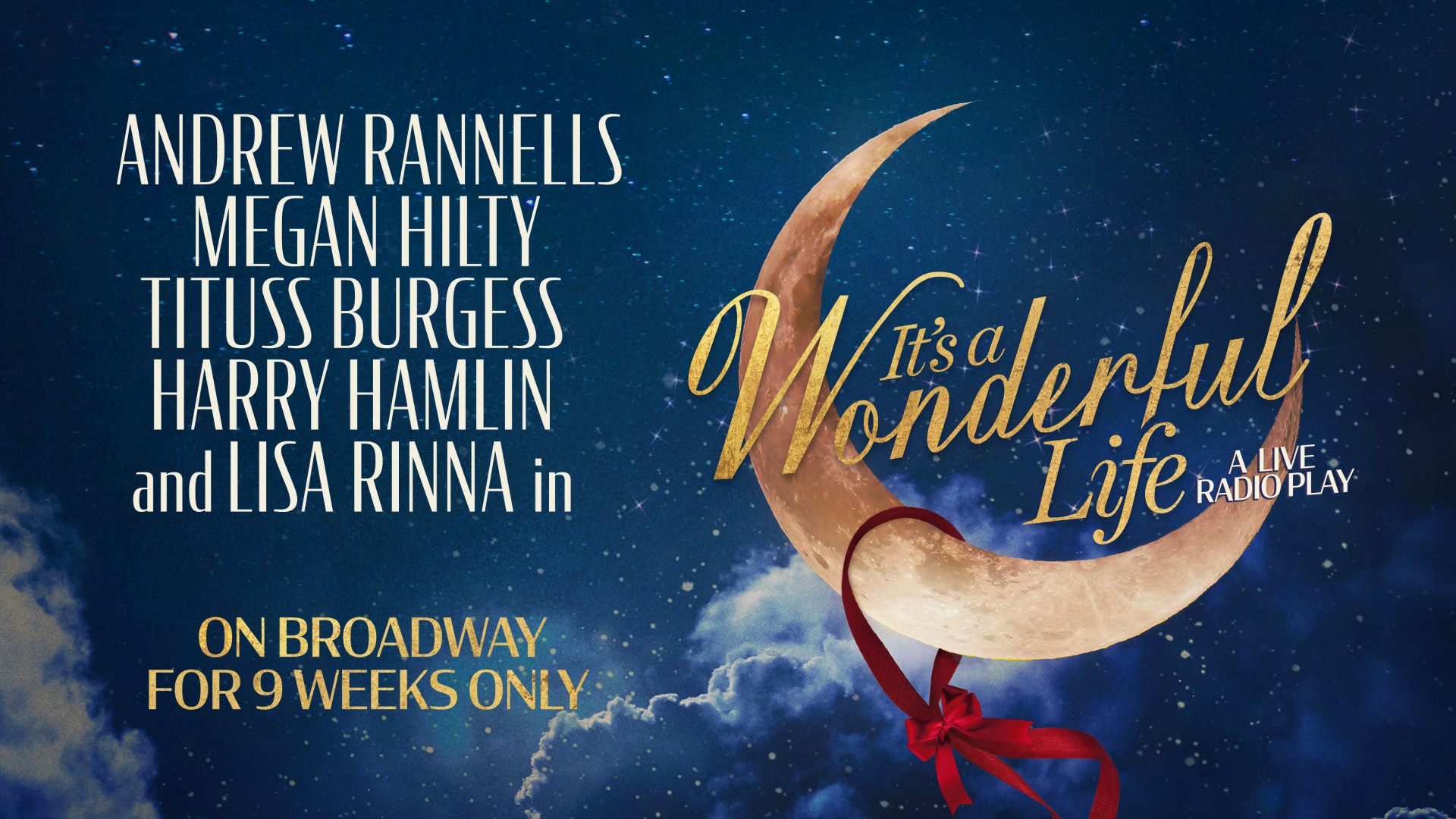
Frank Capra's 1946 film reimagined as an on-air radio show from the 1940s: a small cast voices dozens of roles, a foley artist makes the sounds onstage and carols fill the breaks.
Quick take
- Play
- 1h 30m · no intermission
- Broadhurst Theatre
- Opens Nov 18
- Based on the 1946 film It's a Wonderful Life and the 1943 story The Greatest Gift by Philip Van Doren Stern
- 8 performances a week, dark on Mondays
It's A Wonderful Life: A Live Radio Play showtimes
All times Eastern. Schedule last checked Nov 7
- 2:00 PMMatineeTomorrow
- 7:30 PMEveningCast note: Lisa Rinna is not in this performance
- 7:30 PMEvening
- 7:30 PMEvening
- 7:30 PMEvening
- 2:00 PMMatinee
- 7:30 PMEvening
- 1:00 PMMatinee
Our guide to It's A Wonderful Life: A Live Radio Play
On this page 9 sections
What it is
It's a Wonderful Life: A Live Radio Play is a holiday play by Joe Landry that retells the 1946 Frank Capra film as a radio drama broadcast live in the 1940s. Rather than putting the movie itself onstage, it performs the story as a show going out over the air. A small company of actors gives voice to a whole town, a foley artist produces the sound effects live in full view, and carols fill the broadcast's commercial breaks. The people in the seats take the part of the studio audience.
The story behind it is a familiar one. The film, with James Stewart as George Bailey, earned five Academy Award nominations, Best Picture among them, and joined the National Film Registry in 1990. It grew out of The Greatest Gift, a short story by Philip Van Doren Stern. Landry's radio version dates from 1996 and has gone on to be staged by high schools and professional theaters across the United States.
This production, directed by Jerry Zaks, is the play's first time on Broadway, not a revival or a transfer of another run. It is planned as a limited holiday engagement of nine weeks at the Broadhurst Theatre.
The story
The broadcast tells the story of the film, set in the small town of Bedford Falls, New York. Its hero, George Bailey, is a man who keeps setting his own hopes aside for the sake of other people. The habit starts in childhood. As a boy he pulls his younger brother, Harry, out of an icy pond, and he keeps the druggist, Mr. Gower, from sending a poisoned prescription out the door.
As George grows up, his plans to travel and to study are put off again and again. When his father dies, he stays in town to run the family firm, the Bailey Brothers Building and Loan. Its great rival is the banker Henry F. Potter, the wealthiest and coldest figure in the county, who would be glad to see the firm shut its doors for good.
George marries Mary Hatch, who becomes Mary Bailey. When frightened customers line up to pull out their savings, the newlyweds hand over their honeymoon money to keep the Building and Loan afloat. Under George the firm goes on to build Bailey Park, a neighborhood of affordable homes that lets families leave Potter's rentals behind. Potter offers George a well-paid job, and George turns him down.
The crisis arrives on Christmas Eve. Uncle Billy loses track of the firm's cash deposit, Potter quietly keeps the money, and George suddenly faces ruin and the threat of arrest. Prayers offered on his behalf are heard in Heaven, and an angel named Clarence is sent down to help. Clarence is an angel second class who has not yet earned his wings. The rest of the plot is saved for the final section of this page.
The writing
Landry writes for the ear. Voices, music and live sound carry the story that sets and special effects would carry in a conventional staging, and the audience is invited to picture Bedford Falls rather than look at it. The play's licensor files it as a radio play, a dramatic comedy and a Christmas title adapted from a film.
The licensed script places the broadcast in Studio A of radio station WBFR in Manhattan on Christmas Eve 1946. In it, the actors portray a troupe of 1940s radio performers, who have names of their own, and those performers in turn voice George, Mary, Clarence, Potter and the rest of the town. It is written for a cast of five, two women and three men, along with a stage manager whose voice can be heard live or on a recording, and companies may enlarge the cast. As of October 2026, the Broadway team had not said whether it keeps the radio performers and the stage manager from that frame.
Concord Theatricals licenses the play in two lengths: a full-length version of about 90 minutes and a shorter version. The source material is older than the film. Stern first self-published The Greatest Gift in 1943 in booklet form, and a book edition followed in 1944; its premise owes a loose debt to A Christmas Carol by Charles Dickens.
The production
The key thing to know before you sit down is that you are watching a broadcast being made, not a film being re-created onstage. The Broadway production sets the evening at Christmastime in a 1940s studio perched high over New York City. A foley artist works onstage, so each effect is produced in front of you at the moment you hear it. The list of carols sung in the commercial breaks had not been published as of October 2026.
As of October 2026, the official cast lists five performers. Andrew Rannells plays George Bailey and Megan Hilty plays Mary Bailey. Tituss Burgess plays Clarence, Harry Hamlin plays Mr. Potter and Lisa Rinna plays Violet, and each of those three also voices several other characters, so that the company covers dozens of roles between them. The production had not announced who performs the sound effects.
Rannells originated Elder Price in The Book of Mormon, a role that brought him a Tony nomination, and he won a Grammy Award for the show's cast album; a second Tony nomination came for Falsettos. On television he played Elijah on the HBO series Girls. Hilty played Glinda in Wicked on Broadway, created Doralee Rhodes in 9 to 5 and Madeline Ashton in Death Becomes Her, and earned Tony nominations for Noises Off and Death Becomes Her; on the NBC series Smash she was Ivy Lynn.
Burgess is known for Titus Andromedon on Unbreakable Kimmy Schmidt. Hamlin is known for L.A. Law and Clash of the Titans, his work on Mad Men brought him an Emmy nomination, and his earlier Broadway credits include Summer and Smoke. Hamlin and Rinna are married, and they have shared a Broadway stage before: Rinna's first Broadway role was Roxie Hart in Chicago in 2007, opposite Hamlin as Billy Flynn.
History
The play began small. Landry has recalled that Frances Kondziela, a longtime friend and teacher, asked him for a stage version of the story that she could direct with her high school ensemble at Fairfield High School. A full-scale version followed at TheatreWorks in New Milford, Connecticut. Westport Country Playhouse is reported to have picked that version for a professional production and then dropped it when the budget grew too large, and that setback is when the idea of a live radio play took shape.
The radio version had its first production in 1996 at the Stamford Center for the Arts in Stamford, Connecticut, where the script was refined into the version that was later published. From there it traveled. In Chicago, American Blues Theater gave Landry's adaptation a full production in 2004, directed by Marty Higginbotham. Bucks County Playhouse staged it in 2012, and Pasadena Playhouse gave it 15 performances in December 2018, with Simon Helberg as George Bailey and Cameron Watson directing. Hartford Stage presented it in 2021.
The play is also a fixture in schools. An Educational Theatre Association survey of the 2020–2021 school year placed it third among full-length plays produced by American high schools, and American Theatre magazine has named it one of the ten most-produced plays. Over roughly 30 years it has become one of the most widely produced plays in America.
The Broadway cast was announced on October 1, 2026. Previews were scheduled to start at the Broadhurst Theatre on November 4, 2026, with opening night set for November 18, 2026.
The ending (spoilers)Contains spoilers. Tap to read
On a bridge that Christmas Eve, George wishes he had never existed, and Clarence lets him see what that world would look like. The town is called Pottersville, and the people George helped are far worse off without him. George begs to have his old life back and hurries home, where Mary and Uncle Billy have rallied the town. Donations from neighbors make up the missing money, and when a bell rings, it means Clarence has his wings at last.
Creative team & cast
Creative team
Joe Landry wrote the adaptation, and he has used the same format for other material: The Great Gatsby, A Christmas Carol and Vintage Hitchcock are among the titles he has given the radio treatment. He studied at Playwrights Horizons/NYU, and he has taught playwriting classes at Sacred Heart University. Philip Van Doren Stern receives credit for the original story.
Jerry Zaks directs. Of his eight Tony nominations, four ended in wins, and in 2013 he entered the Theater Hall of Fame. His Broadway credits include The House of Blue Leaves, Lend Me a Tenor and Guys and Dolls, as well as a production of The Music Man led by Hugh Jackman and Sutton Foster. Zaks has said that the radio format looks back to an earlier era and that the production also has surprises planned for today's audiences.
Santo Loquasto designs both the sets and the costumes. He is also a four-time Tony winner, with more than 60 Broadway productions to his name, and he and Zaks worked together on The Music Man. Kenneth Posner, whose Broadway lighting credits include Wicked, Hairspray, Kinky Boots and Beetlejuice, lights the show. Palmer Hefferan, a Tony nominee for John Proctor Is the Villain, designs the sound. Andy Einhorn is music director; he has been music supervisor and music director of Carousel, among other shows.
Casting is by Taylor Williams. The producers include Seaview, Wagner Johnson Productions, The Shubert Organization, the John Gore Organization and Networks Presentations, and Dylan Glen of Wagner Johnson Productions is the general manager.

- Playwright
- Joe Landry
- Director
- Jerry Zaks
- Music Director
- Andy Einhorn
- Scenic Design
- Santo Loquasto
- Costume Design
- Santo Loquasto
- Lighting Design
- Kenneth Posner
- Sound Design
- Palmer Hefferan
More production credits (4)
- Casting
- Taylor Williams
- Original Story
- Philip Van Doren Stern
- General Management
- Wagner Johnson Productions, Dylan Glen
- Producer
- Seaview, Wagner Johnson Productions, No Guarantees Productions, Broadway & Beyond Theatricals, Pamela Hurst-Della Pietra & Stephen Della Pietra, Jillian Robbins, The Shubert Organization, John Gore Organization, Networks Presentations, Tom Tuft, Scott Abrams, Colleen Cook, Nicholas Kaiser, Stella La Rue, Bruce & Peggy Wanta
Cast
As of October 2026. Casts change during a run, and understudies may appear at any performance.


- George Bailey
- Andrew Rannells
- Mary Bailey
- Megan Hilty
- Clarence and Others
- Tituss Burgess
- Mr. Potter and Others
- Harry Hamlin
- Violet and Others
- Lisa Rinna
Photo credits (6)
- Jerry Zaks: Eva Rinaldi, CC BY-SA 2.0
- Andrew Rannells: PhilipRomanoPhoto, CC BY-SA 4.0
- Megan Hilty: David, CC BY 2.0
- Tituss Burgess: Rubenstein, CC BY 2.0
- Harry Hamlin: Super Festivals, CC BY 2.0
- Lisa Rinna: Kevin Paul, CC BY 4.0
Theater
Broadhurst Theatre
235 West 44th Street, New York, NY 10036
1,186 seats · opened 1917
The Broadhurst Theatre is a Broadway house of 1,186 seats on West 44th Street, owned and run by the Shubert Organization. Its stage has held musicals, revues, dramas and comedies.
Getting there
The theater is at 235 West 44th Street, on the north side between Seventh Avenue and Eighth Avenue, near Times Square. Its block holds more Broadway stages than any other: the Majestic is next door to the west, the Shubert to the east, and the Gerald Schoenfeld, Booth, John Golden and Bernard B. Jacobs fill the rest. Sardi's restaurant, the Hayes Theater and the St. James Theatre are across 44th Street. Look for the stage door on the right as you leave by the main doors.
The main subway option is the Times Sq-42 St complex, which includes 42 St-Port Authority Bus Terminal: the 1, 2, 3, 7, N, Q, R, W and S shuttle on the Times Square side, and the A, C and E at the Port Authority end. The complex is accessible. The 49 St station on the N, R and W (accessible uptown only) and the 50 St station on the C and E (accessible downtown only) are also close.
Open in Apple Maps (opens in a new tab)Open in Google Maps (opens in a new tab)

Questions about It's A Wonderful Life: A Live Radio Play
How long is It's A Wonderful Life: A Live Radio Play?
Where is It's A Wonderful Life: A Live Radio Play playing?
When does It's A Wonderful Life: A Live Radio Play open?
How much are tickets to It's A Wonderful Life: A Live Radio Play?
How many performances a week does It's A Wonderful Life: A Live Radio Play play?
Before or after the show
- Museum of Broadway
- Hell's Kitchen food tour before the show
- Empire State Building observation deck
- SUMMIT One Vanderbilt
- Statue of Liberty and Ellis Island ferry
More Broadway plays


Spotted an error on this page? Tell us and we will fix it.