
Here There Are Blueberries
A documentary play by Moisés Kaufman and Amanda Gronich
A true-story documentary play: researchers at the Holocaust Memorial Museum investigate an SS officer's album of Auschwitz staff at leisure in 1944, and descendants face what it shows.

Quick take
- Play
- 1h 30m · no intermission
- Barrymore Theatre
- Ages 12+
- Opens Nov 9
- Winner of 2 Lucille Lortel Awards
- Based on the Höcker Album, SS officer Karl Höcker's photo album from Auschwitz
- 7 performances a week
Here There Are Blueberries showtimes
All times Eastern. Schedule last checked Nov 7
- 3:00 PMMatineeTomorrow
- 6:30 PMEveningCancelled
- 7:00 PMEvening
- 1:00 PMMatinee
- 7:00 PMEvening
- 7:00 PMEvening
- 2:00 PMMatinee
- 7:00 PMEvening
Our guide to Here There Are Blueberries
On this page 9 sections
What it is
Here There Are Blueberries is a documentary play written by Moisés Kaufman and Amanda Gronich and developed by Tectonic Theater Project, the New York company that made The Laramie Project. It tells a true story from the recent past. A photo album kept by an SS officer at Auschwitz reaches Washington's United States Holocaust Memorial Museum, and the people who study it, along with the families tied to the faces inside, have to work out what it means.
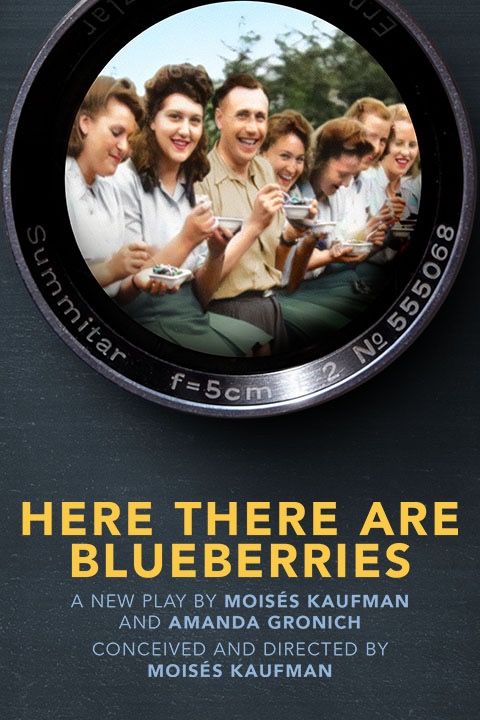
The album belonged to Karl Höcker, who served as adjutant to Richard Baer, the final commandant at Auschwitz. Taken between May 1944 and January 1945, its pictures catch the camp's officers and staff at parties and day trips as well as ceremonies and official visits. Not a single one shows a prisoner. The title comes from Höcker himself: Hier gibt es Blaubeeren is the caption he penned under a set of staged photos of young female SS auxiliaries posing with bowls of blueberries.
This is the play's first Broadway production, at the Ethel Barrymore Theatre, and La Jolla Playhouse, where the world premiere took place in 2022, is a co-producer. It arrives with a track record: a place among the 2024 finalists for the Pulitzer Prize for Drama and two 2025 Lucille Lortel Awards for its Off-Broadway run.
The story
The present-day story begins in 2007. An American veteran who asks to stay anonymous offers the Holocaust Memorial Museum a wartime album he had found in Germany in 1946. Two staff members take it on: Rebecca Erbelding, an archivist and historian, and Judy Cohen, head of the museum's collection of reference photographs. Their questions are basic ones. Who are these people? Where and when were the pictures taken? And whose album was it?
Kaufman and Gronich stage the research as a detective story. The audience watches the two women confirm one detail at a time. The photos turn out to show the SS staff of Auschwitz off duty in 1944, including the young women auxiliaries with their blueberries at a retreat about 20 miles from the camp. That creates a problem the museum has to argue through. With no prisoners anywhere in the frame, the pictures could be misused by Holocaust deniers, so the staff debate whether to release them at all, and if so, how.
Publicity widens the circle. When the museum's find becomes international news, a German businessman spots his grandfather among the faces in the images posted online. That moment leads him to other children and grandchildren of Nazi perpetrators, and to a hard look at his family's past and Germany's. The play gives voice to three of these descendants: Tilman Taube, whose grandfather, the SS doctor Heinz Baumkötter, is in the album; Peter Wirths, whose father, Eduard Wirths, served as chief SS physician at Auschwitz; and Rainer Höss, grandson of Rudolf Höss, the camp's first commandant. Each wrestles with what he inherited and with how much of it to say out loud.
The play also brings in a second album. Known as the Auschwitz Album, it belonged to survivor Lili Jacob and shows Hungarian Jews arriving at Birkenau in late May 1944. The play places the two collections side by side, so that pictures of the people who ran the camp sit next to pictures of the people sent there.
The writing
Each character is drawn from a real person, and much of the dialogue comes from interviews the two writers conducted while researching the play, with Tectonic artists adding historical research of their own. That is how the company generally builds its work: through shared research and studio experiment, using Moment Work, the theater-making method Tectonic devised and trademarked.
The project started with one image. Kaufman came across the blueberry photograph in 2007, when The New York Times ran it on page one, and he sensed a possible play in it. In November 2010 he traveled to the museum to meet Erbelding and see the pictures for himself, and the piece went on to spend close to a decade in development before its 2022 premiere. Kaufman has spoken about his father being a Holocaust survivor. Gronich, who is also Jewish, had never written about the Holocaust before.
The writers made a deliberate choice about point of view: the perpetrators, not the victims, sit at the center, and the question is what such ordinary-looking people reveal about human behavior. The themes follow from that choice: complicity and guilt, the part bystanders play, how ordinary people end up taking part in genocide, and the gap between what a photograph shows and what it leaves outside the frame.
On Broadway the play runs as a single act performed by eight actors, each billed in one named role and doubling in others. Beyond the researchers and the descendants, the real figures on stage include Höcker himself; the museum's director, Sara J. Bloomfield; Pawel Sawicki, who handles communications for the Auschwitz-Birkenau State Museum; Melita Maschmann, a former leader of press and propaganda work in the League of German Girls; Lili Jacob; and Charlotte Schünzel.
The production
The production does away with the fourth wall. The photographs are projected for the audience, who are told plainly that every image is genuine, and the actors study and decode them in real time. Gronich has described the pictures as the actors' scene partners.
As of October 2026, the announced Broadway cast is Scott Barrow as Karl Höcker, Michelle Beck as Charlotte Schünzel, Michael Cerveris as Peter Wirths, Kathleen Chalfant as Judy Cohen, Delia Cunningham as Rebecca Erbelding, Brandon Flynn as Rainer Höss, Montego Glover as Melita Maschmann and Conrad Ricamora as Tilman Taube. Barrow, Chalfant and Cunningham are Tectonic members returning to roles from earlier stagings; Barrow was Höcker at La Jolla in 2022 and in London in 2026. Among the newcomers, Cerveris is a two-time Tony winner whose credits include Fun Home, Beck has appeared in A Raisin in the Sun, Glover in An American Daughter, and Flynn is known from 13 Reasons Why. The understudies are Grant James Varjas, Marrick Smith, Anna Shafer and Jeanne Sakata.
History
The piece had an early showing in 2018, when it was still called The Album, at Miami Beach's Colony Theatre, presented by Miami New Drama. The world premiere came on July 26, 2022, at La Jolla Playhouse in San Diego, in its Sheila and Hughes Potiker Theatre, co-produced with Tectonic; it played through August 21, 2022, and was backed by an Edgerton Foundation New Play Award.
In May 2023 the play went to Washington, D.C., for a run at Shakespeare Theatre Company. Off-Broadway, New York Theatre Workshop presented it with Tectonic: previews began April 17, 2024, the official opening followed on May 13, 2024, and the run was extended to June 30, 2024. That year CBS's 60 Minutes aired a segment by Anderson Cooper about the album and the play, featuring Auschwitz survivor Irene Weiss.
A U.S. tour followed in 2025 and 2026, including a stop at The Wallis in Beverly Hills in March 2025. Across five cities it gave 136 performances and 24 post-show talkbacks with FASPE, an ethics fellowship program that partners with the production on content and conversation, before closing at Seattle Rep in February 2026. London's Theatre Royal Stratford East hosted the UK premiere from January 31 to March 7, 2026, again co-produced with Tectonic. The script is published by Concord Theatricals.
The Broadway engagement was announced on August 27, 2026, as a limited run of 10 weeks, with the first preview set for November 2, 2026, and opening night for November 9, 2026. The Broadway cast and the talkback series were announced on October 15, 2026.
Awards
In 2024 the play was one of the Pulitzer Prize for Drama finalists; Primary Trust took the prize that year. At the 2025 Lucille Lortel Awards, which honor Off-Broadway work, it won Outstanding Play, and David Bengali won Outstanding Projection Design. Kaufman's direction, the ensemble and McLane's scenic design earned nominations.
In 2025 the play was also nominated by the Outer Critics Circle (Outstanding New Off-Broadway Play) and the Drama League (Outstanding Production of a Play). Earlier, in 2022, the script won the Theater J Trish Vradenburg Jewish Play Prize.
Pulitzer Prizes: 1 nomination · Outer Critics Circle Awards: 1 nomination · Drama League Awards: 1 nomination · Lucille Lortel Awards: 2 wins from 5 nominations
| Year | Award | Category | Result |
|---|---|---|---|
| 2024 | Pulitzer Prize | Pulitzer Prize for Drama (finalist) | Nominated |
| 2025 | Outer Critics Circle Award | Outstanding New Off-Broadway Play | Nominated |
| 2025 | Drama League Award | Outstanding Production of a Play | Nominated |
| 2025 | Lucille Lortel Award | Outstanding Play | Won |
| 2025 | Lucille Lortel Award | Outstanding Projection DesignDavid Bengali | Won |
| 2025 | Lucille Lortel Award | Outstanding DirectorMoisés Kaufman | Nominated |
| 2025 | Lucille Lortel Award | Outstanding EnsembleScott Barrow, Nemuna Ceesay, Kathleen Chalfant, Jonathan Raviv, Erika Rose, Elizabeth Stahlmann, Charlie Thurston, Grant James Varjas | Nominated |
| 2025 | Lucille Lortel Award | Outstanding Scenic DesignDerek McLane | Nominated |
| 2022 | Other award | Theater J Trish Vradenburg Jewish Play Prize | Won |
Creative team & cast
Creative team
Moisés Kaufman conceived the piece, co-wrote it and directs it. Born in Caracas, Venezuela, in 1963, he moved to New York in 1987 and founded Tectonic Theater Project in 1991, serving as its artistic director. He created The Laramie Project with the company in 2000. His Broadway directing debut, I Am My Own Wife, brought him a Tony nomination for direction, and he has also staged Torch Song, The Heiress, Bengal Tiger at the Baghdad Zoo and his own play 33 Variations on Broadway, the last of which was nominated for the Tony for Best Play. In 2016 he was awarded a National Medal of Arts.
Amanda Gronich, a Tectonic charter member, was among the artists who went to Wyoming to make The Laramie Project. She is an Emmy-nominated writer of nonfiction scripts and has written series for National Geographic Television.
The play was devised with Scott Barrow, Amy Marie Seidel, Frances Uku and Grant James Varjas, together with the wider Tectonic company. Seidel is also the associate director and dramaturg.
Broadway uses the same five designers who were credited at the La Jolla premiere, at New York Theatre Workshop and in London: Derek McLane (sets), Dede Ayite (costumes), David Lander (lighting), Bobby McElver (sound) and David Bengali (projections). Casting is by Stephanie Yankwitt, and Erin Gioia Albrecht is the production stage manager. Tectonic Theater Project is the lead producer, with La Jolla Playhouse as co-producer and a group of other producers alongside.
- Playwright
- Moisés Kaufman, Amanda Gronich
- Conceived by
- Moisés Kaufman
- Director
- Moisés Kaufman
- Scenic Design
- Derek McLane
- Costume Design
- Dede Ayite
- Lighting Design
- David Lander
- Sound Design
- Bobby McElver
- Projection Design
- David Bengali
More production credits (13)
- Associate Director
- Amy Marie Seidel
- Casting
- Stephanie Yankwitt
- Devised With
- Scott Barrow, Amy Marie Seidel, Frances Uku, Grant James Varjas
- Dramaturg
- Amy Marie Seidel
- Production Stage Manager
- Erin Gioia Albrecht
- Company Manager
- Eric Armstrong
- Co-production
- La Jolla Playhouse
- In Association With
- Michael Hormel, Midnight Theatricals
- Executive Producer
- 101 Productions, Ltd.
- General Manager
- Evan Bernardin Productions
- Production Management
- Sightline Productions
- Lead Producer
- Tectonic Theater Project
- Producer
- Brian and Dayna Lee, Bruce Roberts, Sue Vaccaro, Ricky Stevens
Cast
As of October 2026. Casts change during a run, and understudies may appear at any performance.


- Karl Höcker
- Scott Barrow
- Charlotte Schünzel
- Michelle Beck
- Peter Wirths
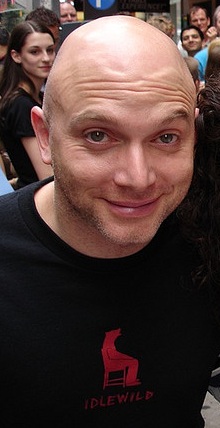
- Michael Cerveris
- Judy Cohen
- Kathleen Chalfant
- Rebecca Erbelding
- Delia Cunningham
- Rainer Höss
- Brandon Flynn
- Melita Maschmann
- Montego Glover
- Tilman Taube
- Conrad Ricamora
Ensemble, swings and understudies (8)
- Judy Cohen (understudy)
- Jeanne Sakata
- Melita Maschmann (understudy)
- Jeanne Sakata
- Rebecca Erbelding (understudy)
- Anna Shafer
- Charlotte Schünzel (understudy)
- Anna Shafer
- Rainer Höss (understudy)
- Marrick Smith
- Karl Höcker (understudy)
- Marrick Smith
- Tilman Taube (understudy)
- Grant James Varjas
- Peter Wirths (understudy)
- Grant James Varjas
Photo credits (5)
- Michael Cerveris: chattingjason, CC BY 2.0
- Kathleen Chalfant: The Make It Fair Project, CC BY 3.0
- Brandon Flynn: Kevin Rios - Vimeo: BINGE, CC BY 3.0
- Montego Glover: Bryan Berlin, CC BY-SA 4.0
- Conrad Ricamora: Casey "Poppins" Nedelka, CC BY-SA 4.0
Theater
Barrymore Theatre
243 West 47th Street, New York, NY 10036
1,058 seats · opened 1928
The Barrymore Theatre is a Shubert Organization house on West 47th Street with 1,058 seats on two levels. It has served as a legitimate playhouse, staging plays and musicals, ever since it opened in 1928. Many listings use the full name, Ethel Barrymore Theatre, while the marquee shows only the surname.
Getting there
The address is 243 West 47th Street, on the north side between Broadway and Eighth Avenue, near Times Square. The Samuel J. Friedman Theatre is on the same block to the west; the Hotel Edison and the Lunt-Fontanne Theatre are to the south. The stage door, a large metal one, is left of the main doors as you exit.
As of October 2026, these are the nearest subway stations and their step-free access:
- 49 St (N, R, W): accessible for uptown trains only
- 50 St, Eighth Avenue line (C, E): accessible for downtown trains only
- 50 St, Broadway-Seventh Avenue line (1): not accessible
- Times Sq-42 St (1, 2, 3, 7, N, Q, R, W, S) and 42 St-Port Authority Bus Terminal (A, C, E): fully accessible
Open in Apple Maps (opens in a new tab)Open in Google Maps (opens in a new tab)

Photo: Andreas Praefcke, CC BY 3.0
Questions about Here There Are Blueberries
How long is Here There Are Blueberries?
What age is Here There Are Blueberries suitable for?
Where is Here There Are Blueberries playing?
When does Here There Are Blueberries open?
How much are tickets to Here There Are Blueberries?
How many performances a week does Here There Are Blueberries play?
Before or after the show
- Museum of Broadway
- Hell's Kitchen food tour before the show
- Empire State Building observation deck
- SUMMIT One Vanderbilt
- Statue of Liberty and Ellis Island ferry
More Broadway plays


Spotted an error on this page? Tell us and we will fix it.